BOTB Pass · Subscription case study · 2025

Turning one-off competition entries into recurring revenue.

A net-new subscription for BOTB, the UK's "win your dream car" company. One Pass automatically enters players into every draw, so the most loyal players never miss out, and an unpredictable purchase business gains a recurring-revenue spine it can finally forecast.
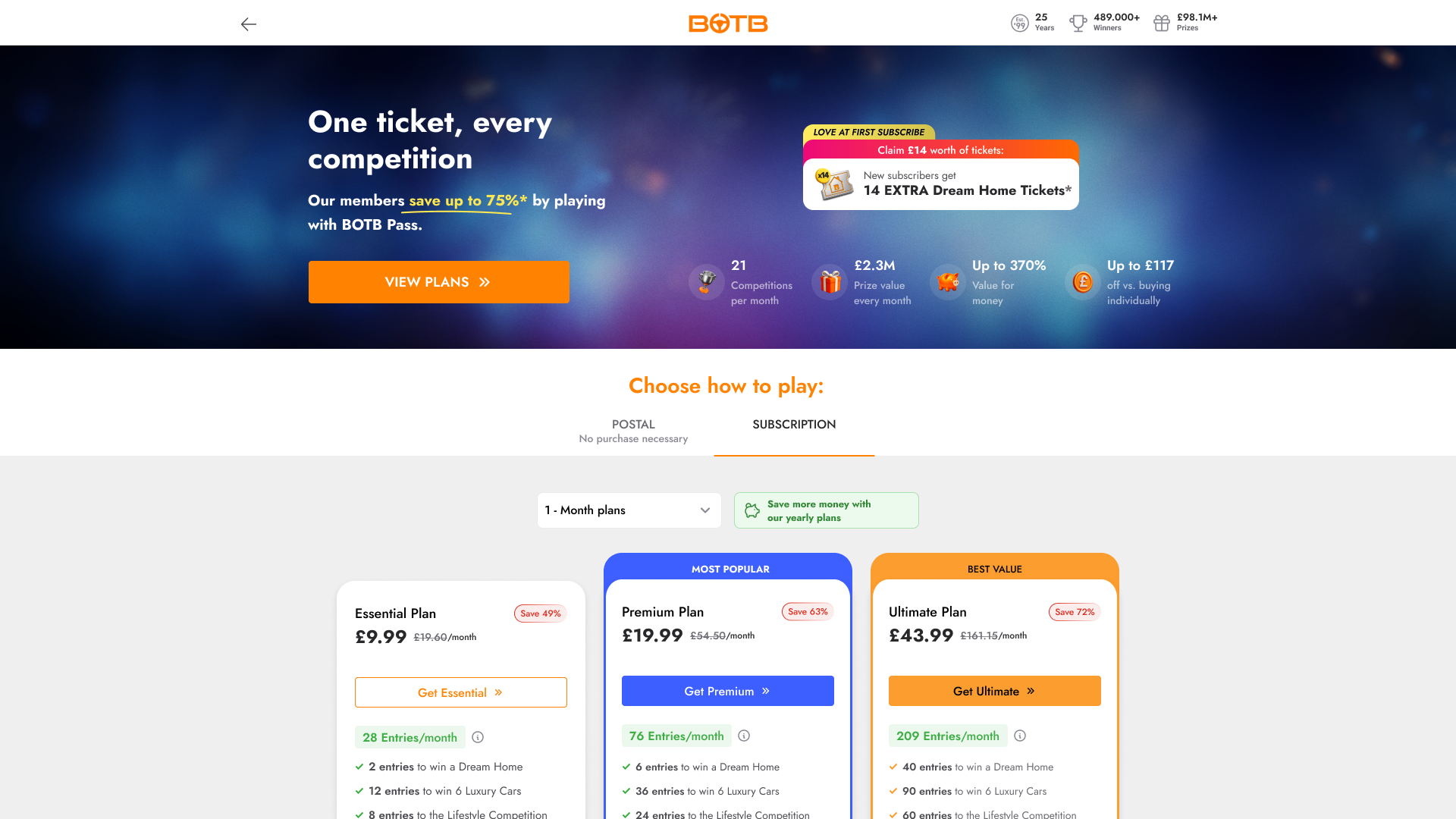
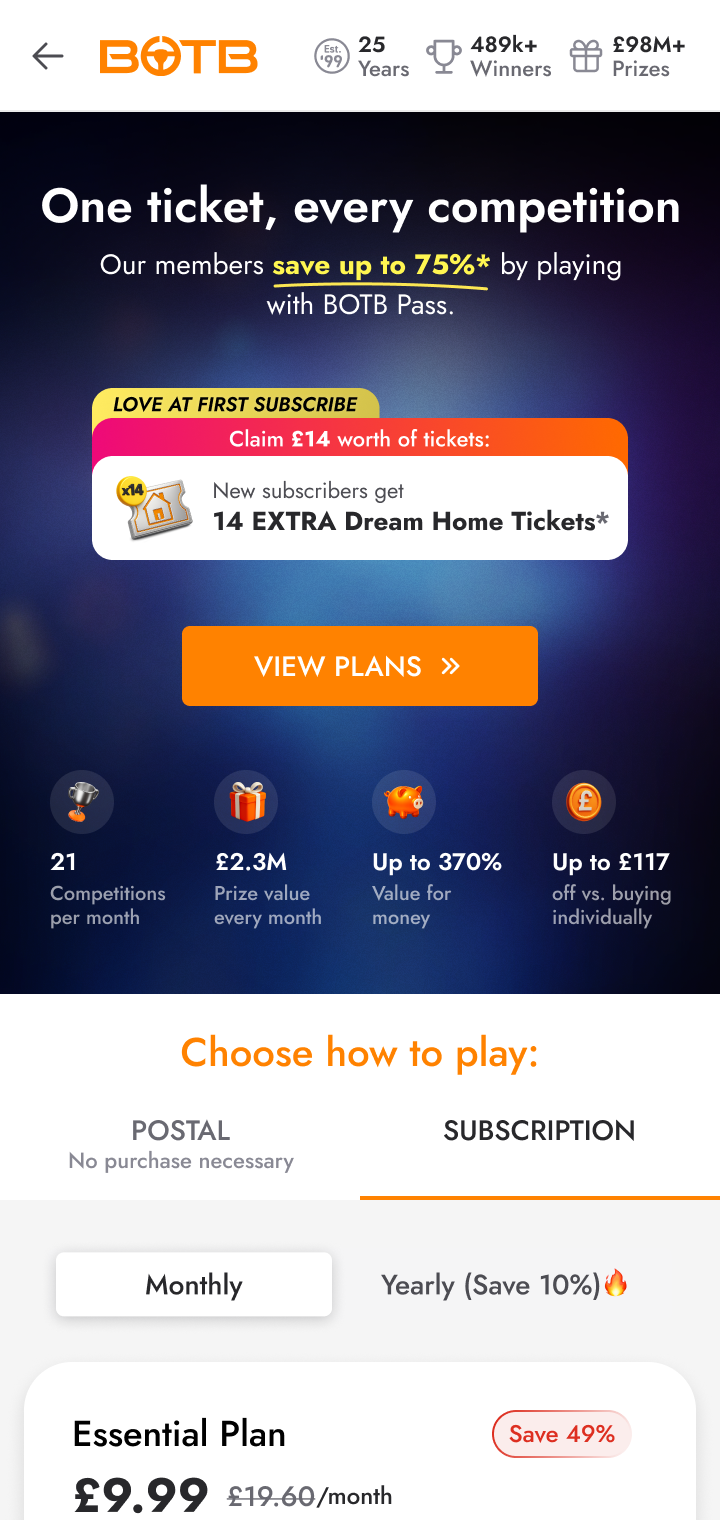
BOTB Pass landing page: desktop
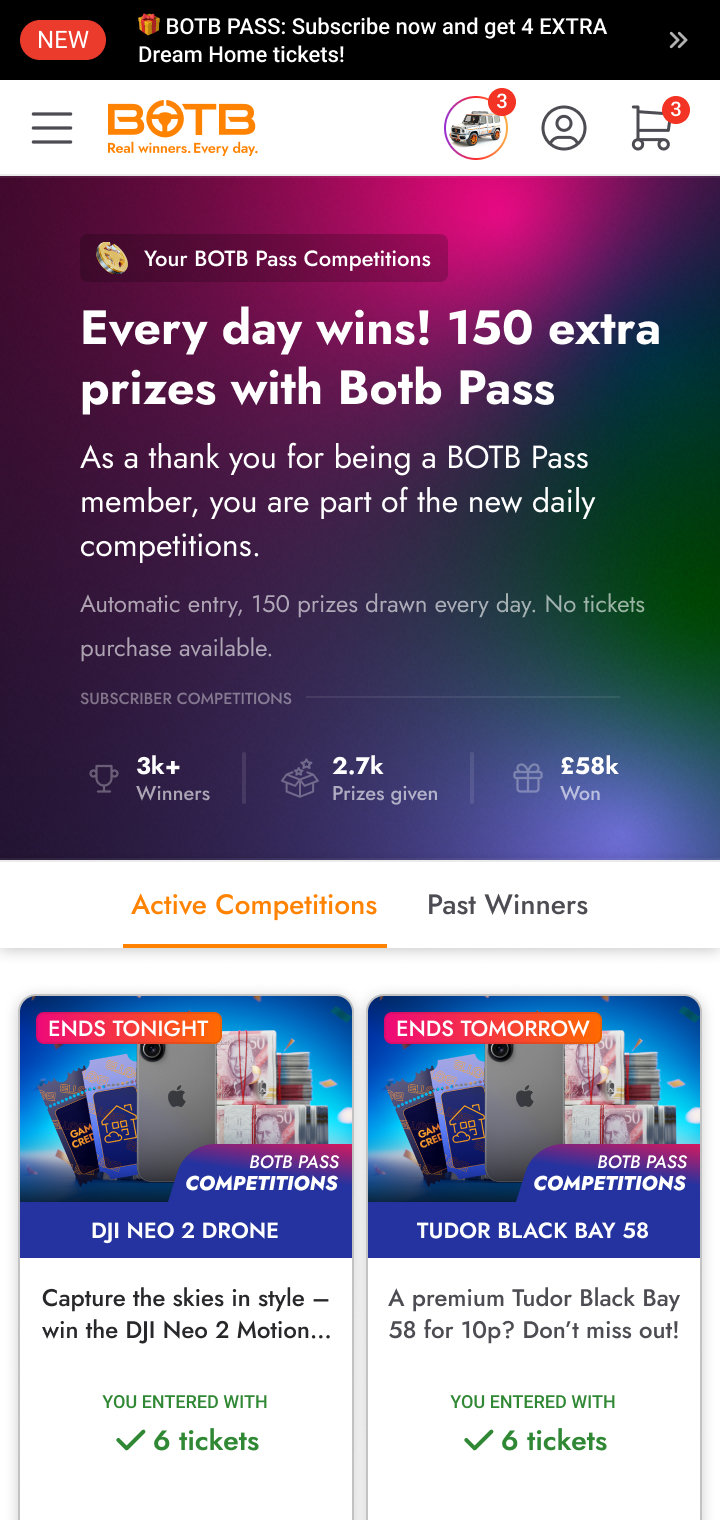
Pass home: you're in for this month's prizes
31% 2%
Missed-draw rate among Pass holders: the "never miss a draw" payoff
33,000+
Active subscribers by year end (approx. 6 months)
£500K+
MRR run-rate by year end (approx. 6 months), from a standing start
Role
UX + product strategy, led design
Team
Cross-functional: product, engineering, brand, customer ops
Timeline
~1 month, 2025
Tools
Figma · Claude · ChatGPT
Platform
Mobile-first (app-led) + web
01
Context & role

A two-decade habit, repeated by hand every week.

BOTB (Best of the Best) has run its "win your dream car" competitions since 1999, with 535,000+ winners and over £155M in prizes given away. Players open the app, pick a competition, and buy an individual entry. Then they do it again next week, and the week after.

For twenty years the business ran on one decision repeated forever. It worked, but it meant revenue arrived in spikes, and the company's most valuable players were carrying the entire ritual on memory alone.

What I owned

  • End-to-end UX, discovery to manage-subscription
  • Making the entry mechanic legible to players
  • Plan / tier modelling & value framing
  • IA for entry points across the app
  • Design QA through build

What I shared

  • Product strategy & pricing, with product + finance
  • Entry-engine logic, with engineering
  • Visual language, with the in-house brand team
  • Go-to-market framing, with growth
02
The challenge & strategic framing

Two problems, one shape.

Business problem

Revenue came in unpredictable bursts. With no recurring base, BOTB had little MRR/ARR visibility: hard to forecast, hard to value the company on recurring terms, hard to plan inventory of prizes against.

User problem

The most loyal players, people who play every month, kept forgetting to enter and missing draws they'd have happily entered. The pain wasn't price. It was absence: looking up the morning after and realising they'd missed one.

Problem statement

How might we let BOTB's most habitual players guarantee their place in every draw, turning existing loyalty into recurring revenue, without compromising the trust a competition product depends on?

Strategic considerations · the real tensions
i

Trust & transparency

A product that "auto-enters" can never feel like it obscures what you're paying for, or buys an unfair edge. Every ticket had to stay visible and accountable.

ii

Legible complexity

Four distinct entry mechanics sit under the hood. The Pass only works if a player understands, at a glance, what it does for each one.

iii

LTV vs. cannibalisation

Convert one-off buyers without simply discounting revenue we'd have earned anyway. The Pass had to expand entries, not just repackage them.

03
Research & insights

The behaviour was already a subscription, just an unreliable one.

Two users mattered: the forgetful regular, a monthly player re-entering by hand every week, and the new discoverer finding BOTB for the first time. We anchored the product on the regular, and three insights drove the design directly.

01

Monthly players were re-subscribing by hand.

In interviews, regulars described a weekly ritual of remembering, opening the app, and re-entering the same draws. The habit was already subscription-shaped. It just ran on willpower and memory.

Cause · habit already exists Effect · frame the Pass as automating a habit, not selling a membership; copy leads with "never miss a draw"
02

Players equate value with seeing their entries.

When early concepts hid tickets behind "it's handled," testers got anxious; they couldn't tell what they were paying for. Invisibility read as risk in a competition context.

Cause · trust needs visibility Effect · the Pass shows exactly what it entered you into, every single draw
03

Heavy players take deliberate breaks.

Regulars talked about consciously stepping back for a month, a personal time-out. With only a hard cancel available, a temporary break became a permanent exit.

Cause · breaks are part of the behaviour Effect · build Pause as a first-class action, not a retention dark-pattern
04
The core mechanic, explained simply

One Pass, four entry types, one promise.

Bottom line

A Pass turns four different entry mechanics into one promise: you're always in. Three happen automatically. The fourth stays in your hands, by design.

the Pass
BOTB Pass · you're always in
AUTO DRAWS
The regular weekly competitions.
The Pass enters you automatically in every draw, every week.
Auto-entered
MANUAL DRAWS
Marquee competitions players like to choose.
Covered by your Pass, but you can still pick & checkout by hand for the ones you care about most.
Auto + your choice
FREE DRAWS
The no-purchase-necessary entries.
The Pass claims them for you automatically, so you never leave a free entry on the table.
Auto-claimed
SPECIAL / SUBSCRIBER-ONLY AUTO DRAWS
Competitions only Pass holders can enter.
Your Pass unlocks and auto-enters them, a perk that exists only because you subscribe.
Unlocked + auto
Handled automatically by the Pass
Optional manual control retained

Why keep manual draws manual? Testing showed regulars wanted agency over the headline cars. Automating everything would have felt like losing the part of BOTB they enjoy most, so the design protects choice exactly where it matters.

05
Design process

From entry points to a model players could read.

A

IA for entry points: meet players at the moment of friction.

The Pass needed to be discoverable from many surfaces: competition pages, the account area, winners. The highest-intent moment, though, is right after someone enters by hand. So the primary entry point offers the Pass at that exact instant: "liked entering that? never do it by hand again." A banner alone would have been ignored; context did the persuading.

B

Plan / tier modelling: making the entry count mean something.

We needed tiers a player could map to their own behaviour in seconds.

We tried → it confused → we changed

Tried: plans headlined by a single "entries per month" number. In testing, players couldn't translate an abstract count into the draws they actually cared about, so nobody could tell which tier they needed.

Changed to: the same entry counts, but broken down by exactly what each plan enters you into (Dream Home, Luxury Cars, Lifestyle, Instant Win, Dream Car) with per-ticket value, each anchored against buying those entries individually. Comprehension jumped immediately.

C

The landing page: benefit first, mechanic second.

The product's complexity is its strength, but it's a terrible opening line.

We tried → it confused → we changed

Tried: a landing page that led with the four entry types up front. Users got stuck understanding the system before they ever felt the benefit, and bounced.

Changed to: lead with "never miss a draw," prove it with real winners, and let the mechanic live one scroll down for the players who want the detail.

D

Core flows: engineered around first value.

Discovery → landing → plan select → checkout → onboarding → manage. The non-negotiable: the first tickets land immediately, so the promise ("you're in") becomes literally true inside the first minute, before doubt can set in.

06
The solution · key flows

The highest-value moments, end to end.

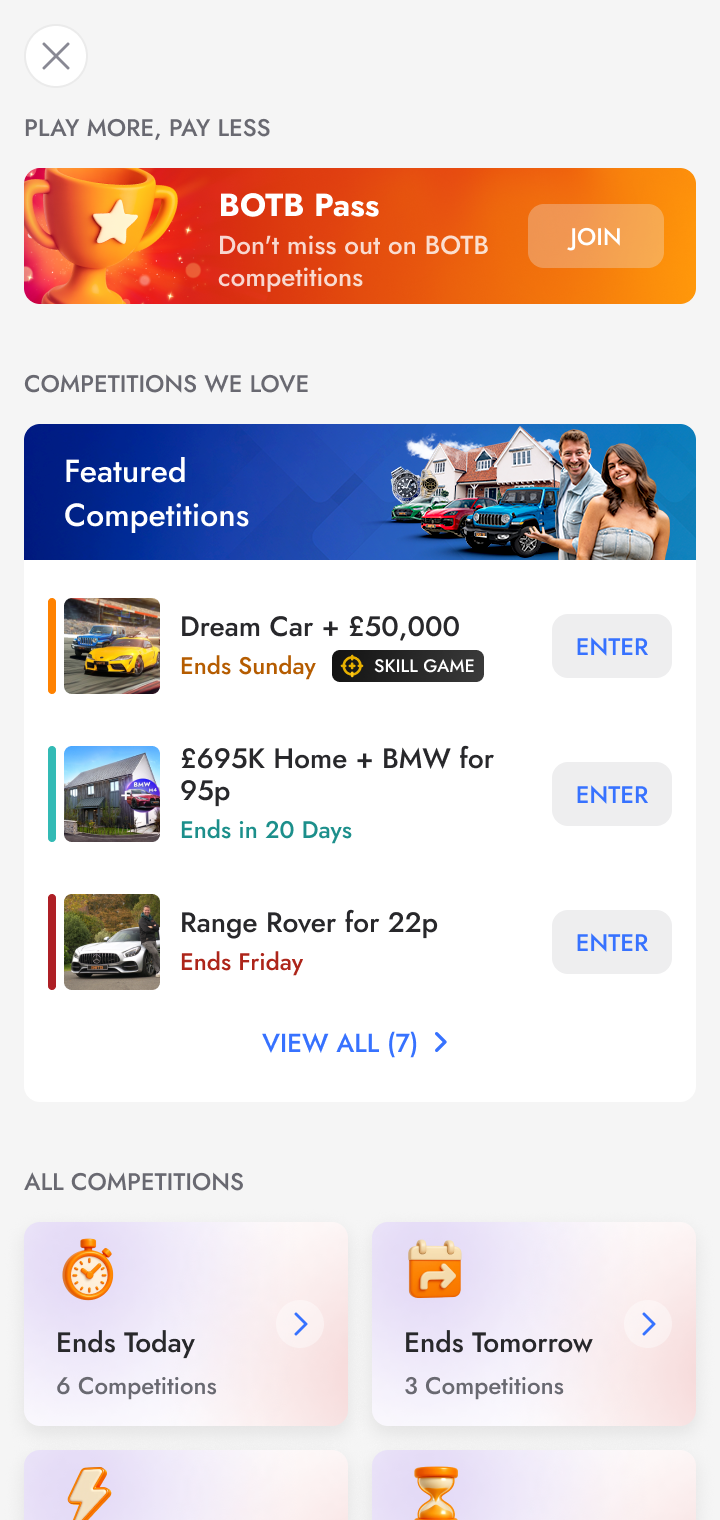
Contextual BOTB Pass offer after a manual entry
a · Entry points

Offer the Pass at the moment of friction.

The strongest pitch lands the instant after someone enters by hand, when the effort is fresh.

  • Triggered post-entry, not as a persistent banner, so it reads as helpful not pushy.
  • Copy references the action just taken: "never do that by hand again."
BOTB Pass landing page: one ticket, every competition
b · Pass landing page

Benefit first. Mechanic second.

Lead with the promise and the proof; reveal the four-type system below the fold for players who want it.

  • Hero states the outcome, not the feature set.
  • Real winners carry credibility before any pricing appears.
c · Plan selection & pricing

Anchor value as savings, not spend.

Three tiers, each broken down by exactly what it enters you into, with one clearly recommended option and every price framed against buying those entries individually.

Yearly · save more
Essential
£9.99£8.32/mo
£19.60/mobilled £99.90/yr
Save 49%2 months free
28 entries / month
  • 2 entries to win a Dream Home
  • 12 entries to win 6 Luxury Cars
  • 8 entries to the Lifestyle Competition
  • 2 entries to any Instant Win Competition
  • 4 entries to the Dream Car Competition (£0.90/ticket)
Get Essential
Most popular
Premium
£19.99£16.66/mo
£54.50/mobilled £199.90/yr
Save 63%2 months free
76 entries / month
  • 6 entries to win a Dream Home
  • 36 entries to win 6 Luxury Cars
  • 24 entries to the Lifestyle Competition
  • 6 entries to any Instant Win Competition
  • 4 entries to the Dream Car Competition (£1.60/ticket)
Get Premium
Best value
Ultimate
£43.99£36.66/mo
£161.15/mobilled £439.90/yr
Save 72%2 months free
209 entries / month
  • 40 entries to win a Dream Home
  • 90 entries to win 6 Luxury Cars
  • 60 entries to the Lifestyle Competition
  • 15 entries to any Instant Win Competition
  • 4 entries to the Dream Car Competition (£4.10/ticket)
Get Ultimate

Every plan breaks its entry count down by what each entry enters you into, with per-ticket value, so the number means something. Blended ARPU lands at ~£15/mo.

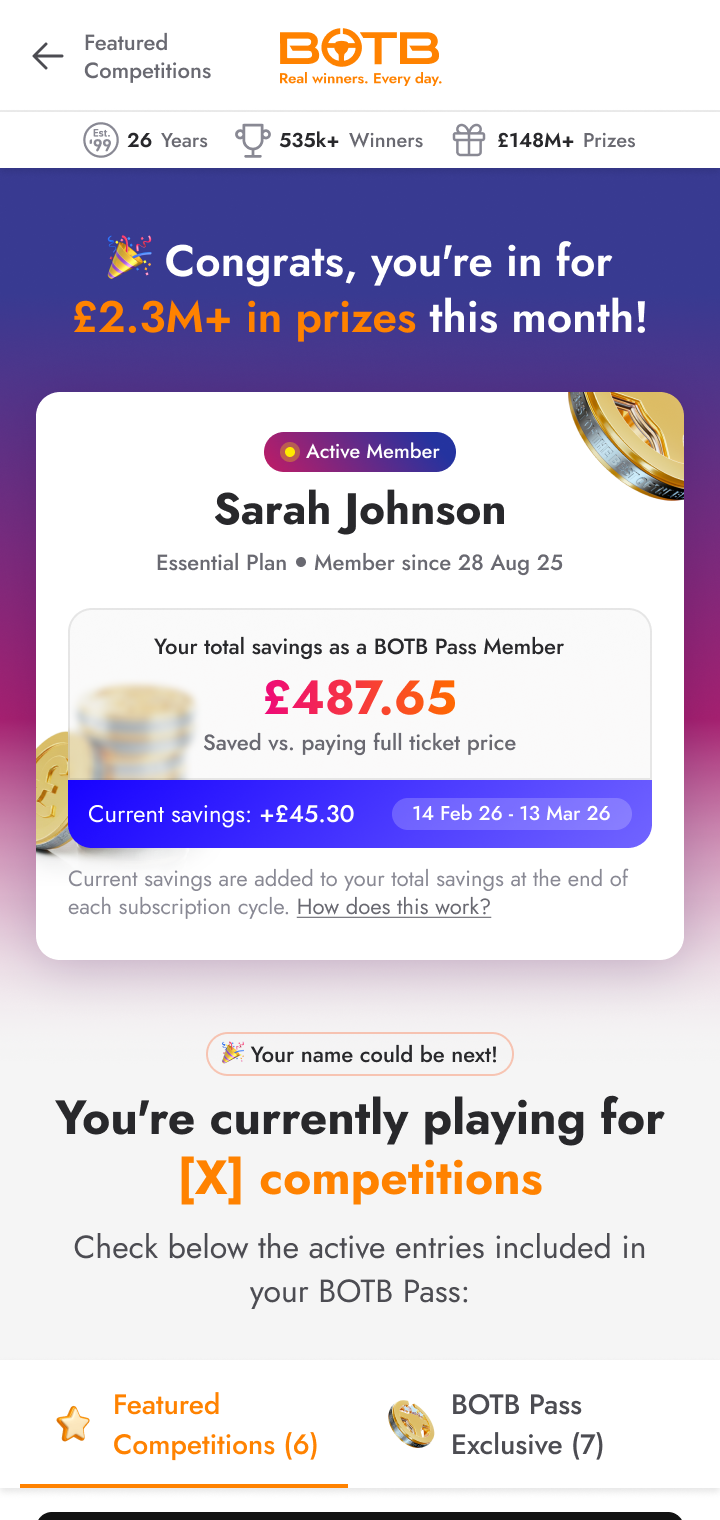
Onboarding: congrats, you're in for this month's prizes
d · Onboarding to first value

Make the promise true in the first minute.

The first tickets land immediately on subscribe, so "you're in" is something the player sees, not something they're told.

  • Confirmation shows the actual draws just entered, visibility as reassurance.
  • Sets the recurring expectation: "this happens for you every week now."
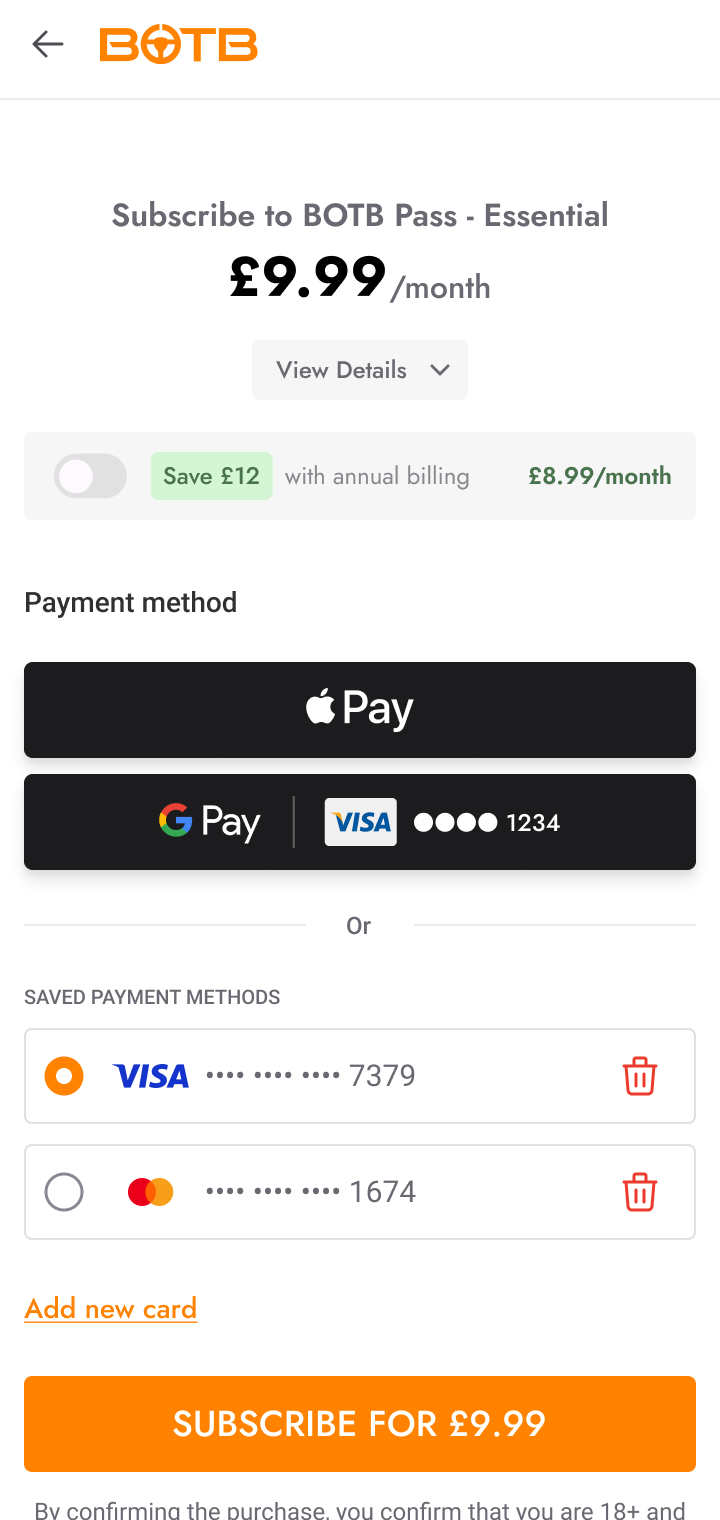
Checkout: subscribe to BOTB Pass Essential, payment methods
e · Billing & checkout

Transparent, fast, cancel-anytime up front.

In a trust-sensitive category, the terms are stated before payment, not buried after it.

  • Plan summary restates exactly what's covered this cycle.
  • "Pause or cancel anytime" shown beside the pay button, not in fine print.
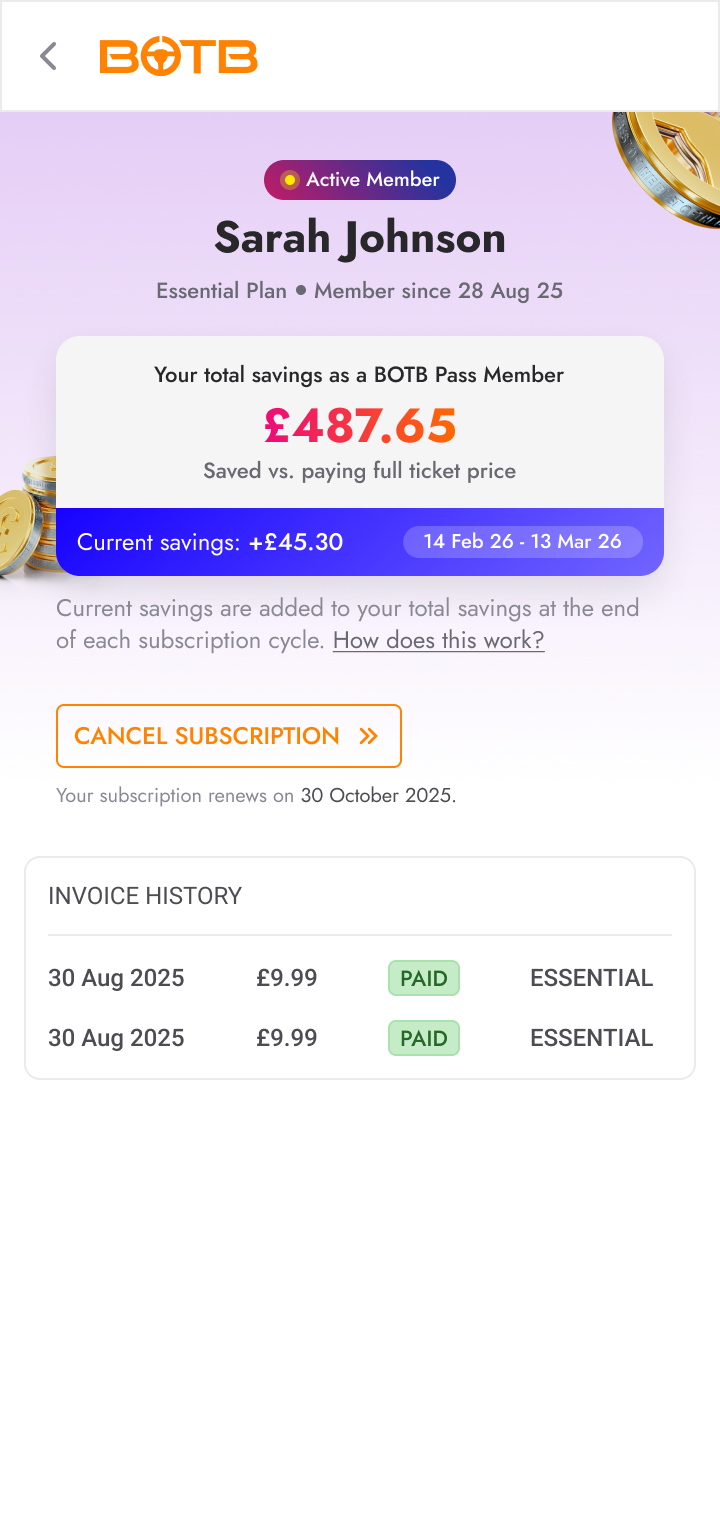
Manage subscription: savings, cancel, invoice history
f · Manage subscription

Let players step back without leaving.

Pause is featured as a first-class option, both best practice and authentic to how BOTB players genuinely take time-outs.

  • Pause sits alongside Upgrade and Cancel, not hidden behind a cancel funnel.
  • Offered before cancel in the exit flow, and 26% of would-be cancellers took it.
  • Resumes cleanly, so a break never becomes a permanent loss.
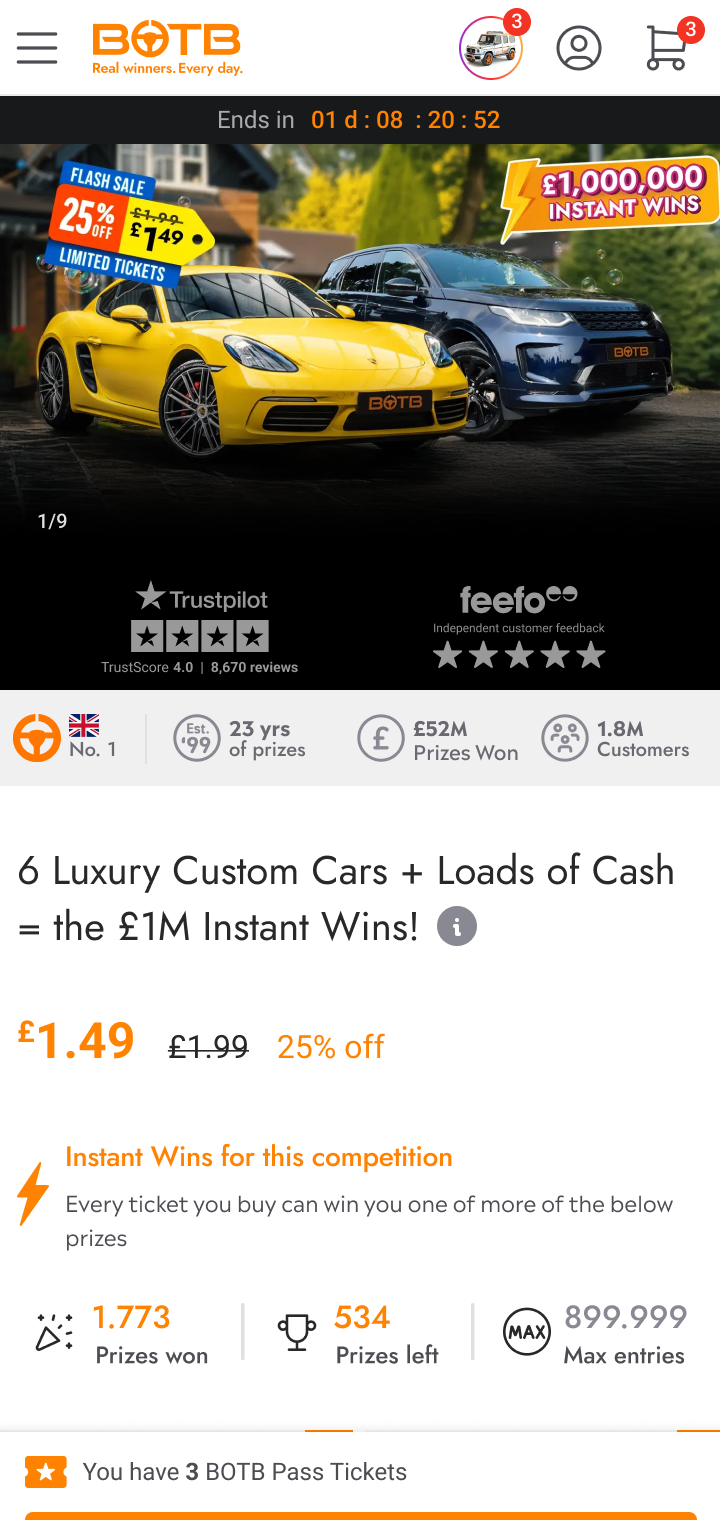
Subscriber-only daily competitions: unlocked for Pass members
g · Subscriber-only competitions

A perk you can see.

Special draws are visibly unlocked for Pass holders, reinforcing ongoing value beyond pure convenience.

  • Locked/unlocked states make the membership benefit tangible.
  • Auto-entry here means the perk requires zero extra effort.
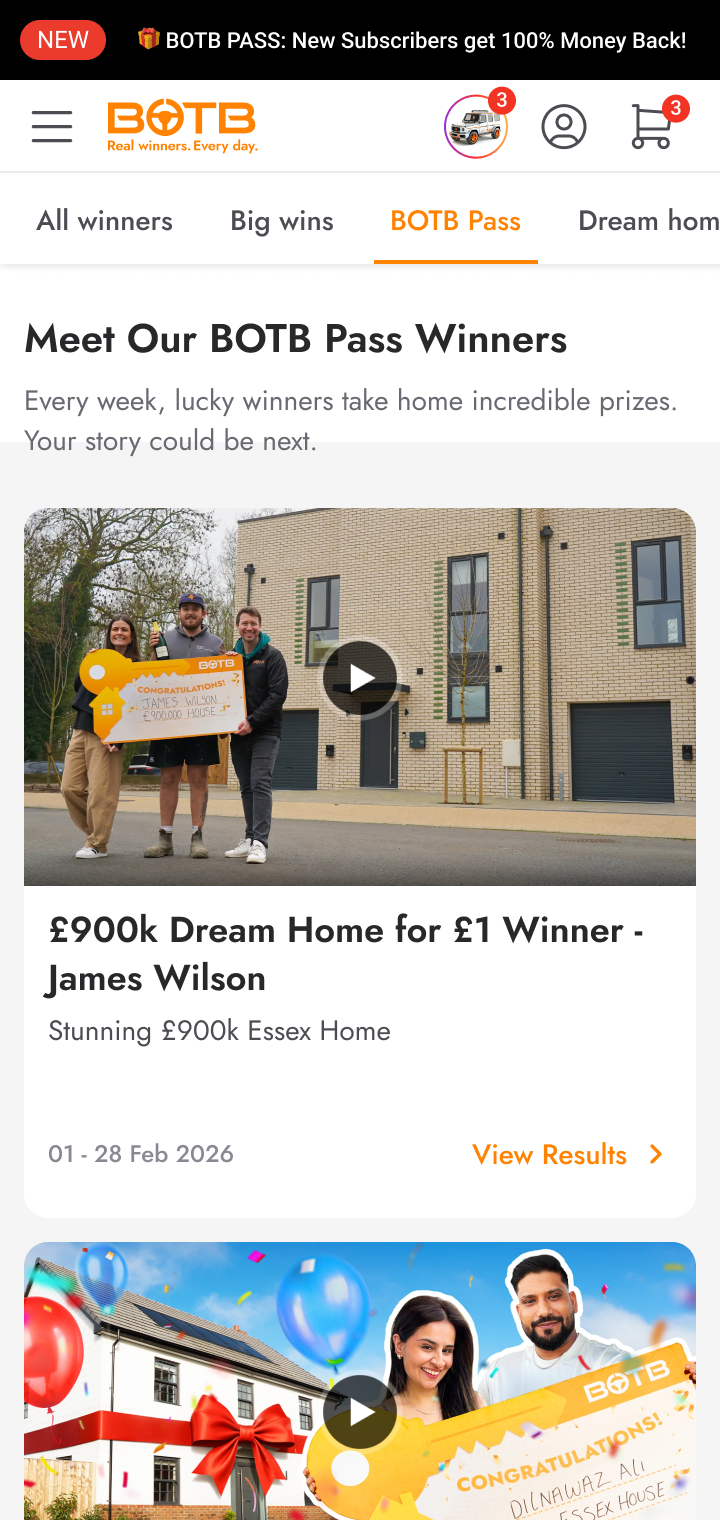
Winners wall: meet our BOTB Pass winners
h · Winners integration

Proof the dream is real.

Real past winners are woven through discovery and onboarding. 535,000+ of them are the strongest argument BOTB has.

  • Recent, real winners, not stock imagery, anchor credibility.
  • Placed before pricing, so belief precedes the ask.
07
Impact

Recurring revenue, and a promise the data proves.

31% 2%

Missed-draw rate among Pass holders: the entire reason the product exists, delivered. "Never miss a draw" became measurably true.

Headline business shift

  • £~£500K MRR by year end (approx. 6 months) · ~£6M ARR run-rate
  • #33,000+ subscribers by year end (approx. 6 months)
  • ~ARPU ~£15/mo (plans from £9.99)
6.8%
Visitor-to-subscriber conversion on the Pass landing page
funnel
22%
Adoption among monthly-active players
funnel
3.4%
Monthly churn
retention
26%
Of would-be cancellers chose to Pause instead
retention
3.8:1
LTV : CAC ratio
unit economics
<7mo
CAC payback period
unit economics
2%
Missed-draw rate among Pass holders (from 31%)
engagement
33k+
Active subscribers, year end (approx. 6 months)
growth
Ramp to year end (~6 months)

Subscribers & MRR to year end, from a standing start

Active subscribers MRR (£)
£38k£105k£195k £300k£405k£500k 2.5k7k13k 20k27k33k M1M2M3 M4M5M6
08
Reflection & what's next

What I'd carry forward.

What I learned

Legibility was the product. Most of the design effort went not into the automation, but into making an automatic thing feel transparent and trustworthy. In a competition product, "you can see your tickets" did more for conversion than any persuasion ever could.

Pause was the highest-leverage decision, and nearly got cut. It was first read as anti-revenue. Reframing it as retention (a break that resumes beats a cancel that doesn't) is what kept 26% of leavers. The senior move was protecting it.

What's next · the roadmap

  • 01Prize-tailored tickets: let players weight entries toward the cars and prizes they actually want, not just "all draws."
  • 02Win-back for paused members: nudge at the moment a relevant dream car appears.
  • 03"Your Pass this month" recaps: surface delivered value to reinforce the visible-tickets insight.
  • 04Gifting & shared Passes: open a new acquisition channel via existing loyalty.
Next case Click Competitions: rebuilding an acquired checkout →

Designing the flow where the stakes are highest.

See all work →